
From the Very Start — A European History of Sign Language Interpreting
May 4, 2026
The story of sign language interpreting in Europe – and where it stands today
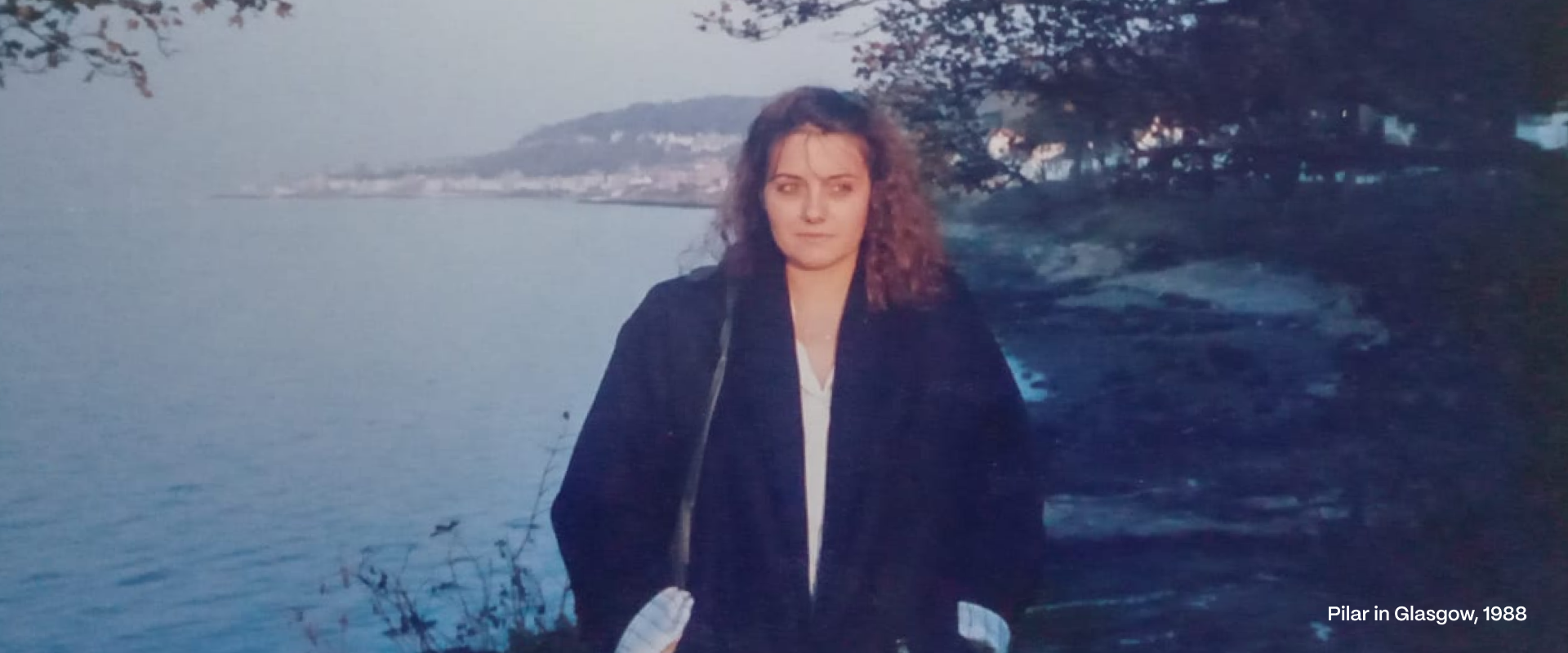
In 1988, a young interpreter from Spain travelled to Glasgow, Scotland. She was around twenty years old. Back home, sign language interpreting was not yet a recognised profession. There were no degrees, no official standards, no professional associations.
She went because interpreters from across Europe had decided — for the first time — to meet and talk about their work.
Her name is Pilar. She is still interpreting today. And when you ask her whether things have changed, her answer is more complicated than you might hope.
20 member associations responded. This article shares what you told us: the priorities that emerged, the role you expect efsli to play, and the concrete directions this opens up. The roadmap's next steps will be built jointly with the board.
When the community was the credential
For most of the twentieth century, sign language interpreting in Europe was not a formal profession. It was a community service.
Most interpreters were CODAs — children of Deaf adults. They grew up with sign language at home. They interpreted for their parents, their neighbours, their community. Not for money. Out of solidarity.
In many countries, Deaf associations were the only ones who could recognise an interpreter. There were no degrees, no official exams.
"At that time in Spain, there were no Bachelor's or Master's degrees in sign language interpreting. The title of interpreter was given by Deaf associations. After an interview, Deaf representatives would issue a card. That card functioned as accreditation."
– Pilar
Researchers have documented this pattern across Europe. Interpreters were trusted by Deaf communities — but invisible to labour law. There were no protections, no minimum rates, no way to ask for better conditions without seeming ungrateful.
"Asking for better working conditions was difficult. Requesting higher pay for travel or weekend work could be seen as asking too much — as taking advantage of the position."
– Pilar
Research would later show that this kind of work environment creates real occupational health risks. Dean and Pollard (2013) described it as a high-demand, low-control situation — one where interpreters absorb a great deal, with very little support. But in the 1980s, none of this had a name.
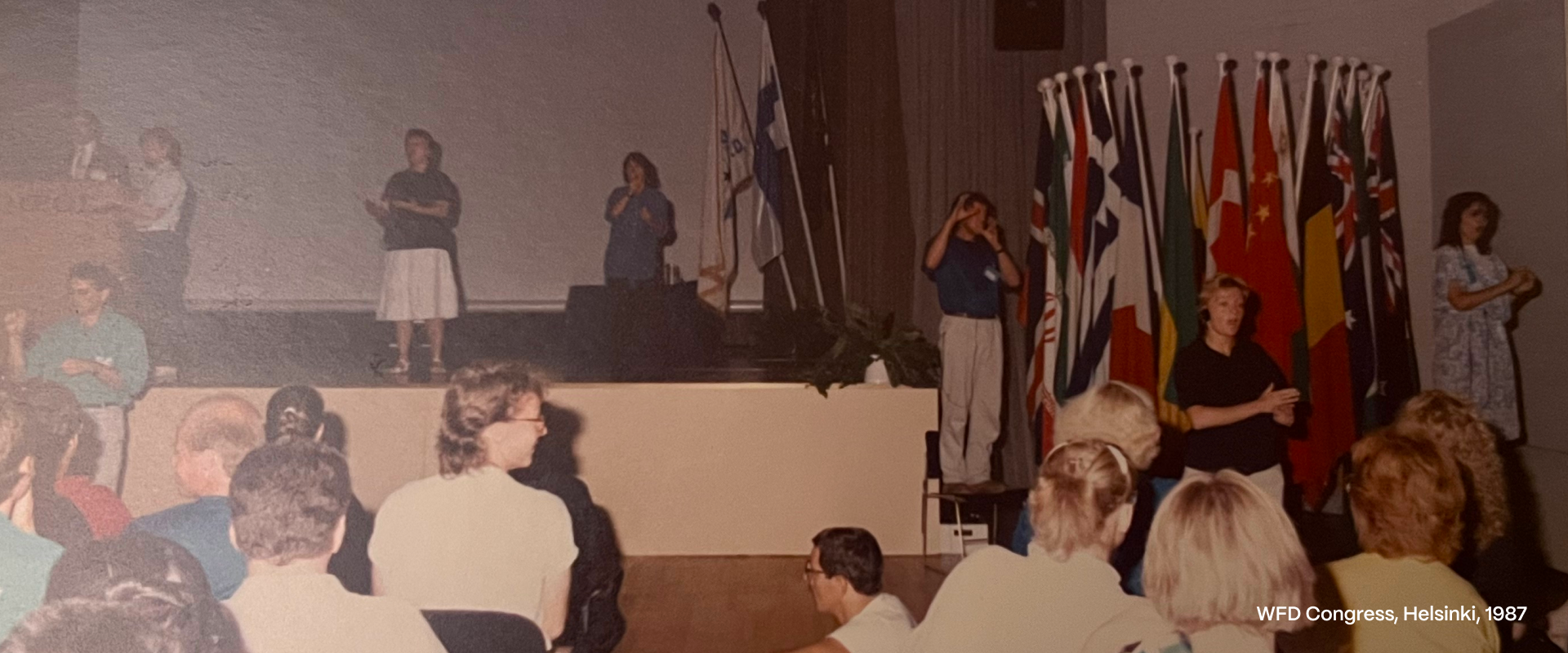
Glasgow, 1988: meeting each other for the first time
In 1987, a conference in Albi, France brought European sign language interpreters together for the first time in an organised setting.
The following year, around 40 interpreters met in Glasgow. It was the first time the profession gathered as a collective across borders.
"When I went to Glasgow, I was impressed by the professionalism of interpreters from other countries. In Spain, the profession was still very informal. We came in colourful outfits — well, Spain — because there were no clear professional norms yet."
– Pilar
What Pilar noticed in Glasgow reflects something researchers have since confirmed: professionalisation in Europe moved at very different speeds in different countries. Where Deaf communities had political influence, things moved faster. Where sign languages had no legal recognition, they moved slower.
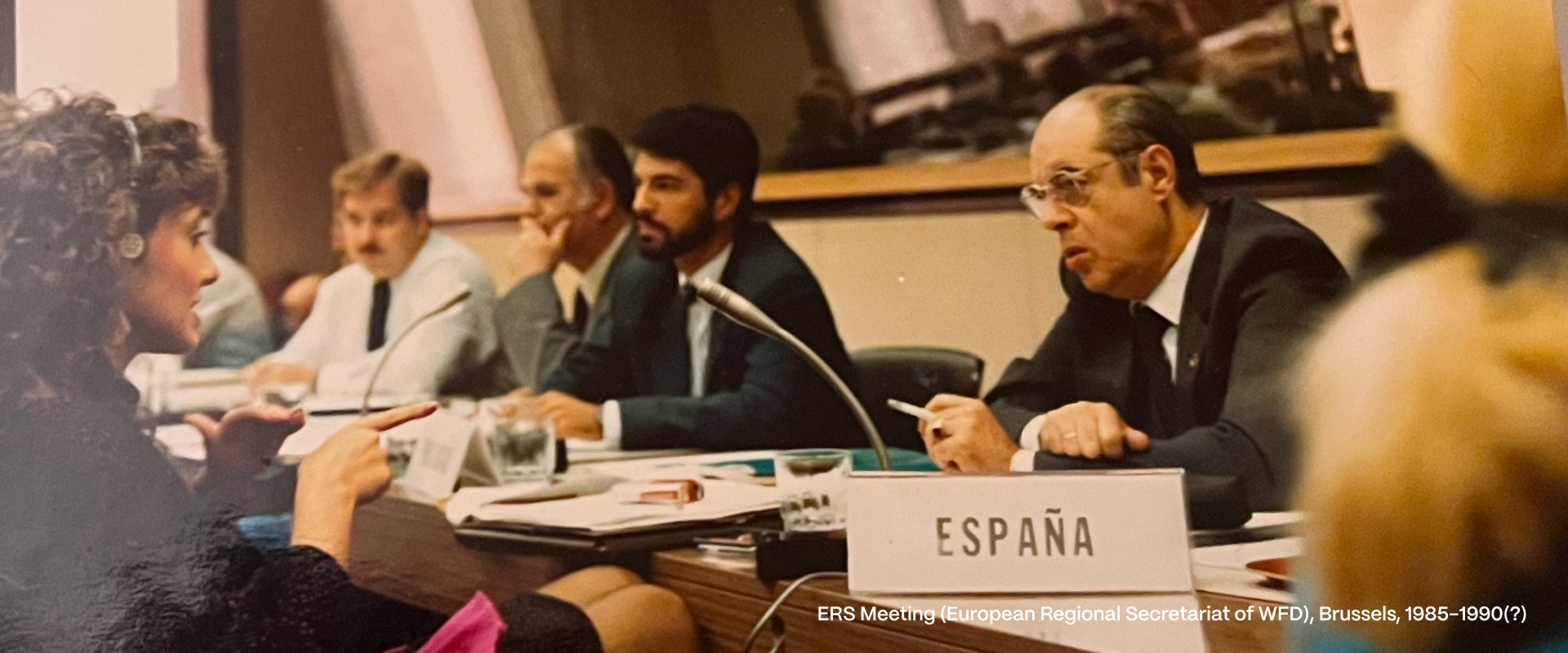
The group kept meeting — in Lisbon, Athens, Brussels, Hamburg. In 1993, they formalised their structure. A board of seven interpreters was elected, from Scotland, Finland, Germany, Denmark, Switzerland, Belgium, and Spain.
The following year, their first formal seminar took "Working Conditions" as its theme. The choice was not accidental.
How the profession changed: key moments
Early 1990s
National associations begin to form
Inspired by the Glasgow meetings, interpreters in many countries start building national associations. In Spain, AMILSE is created. These associations are mostly volunteer-run and underfunded — but they are the first professional infrastructure the field has ever had.
1990
University training arrives
A few European countries begin offering degree-level training in sign language interpreting. Heriot-Watt University in Scotland is among the first. The shift is significant — but slow. In many countries, community-based certification remains the norm well into the 2000s.
1998
European Parliament calls for recognition
The Parliament asks member states to officially recognise their national sign languages. Non-binding — but the first political signal at EU level that sign language access is a right, not a preference.
2006-2009
The first European master's programme
EUMASLI — the European Master in Sign Language Interpreting — is developed through an Erasmus+ project. Three universities collaborate: Magdeburg-Stendal in Germany, Humak in Finland, and Heriot-Watt in Scotland. The first 16 students from 8 countries begin in 2009. For the first time, there is a shared European standard for advanced training.
2016
European Parliament gets specific
A Parliament resolution calls for at least three years of full-time equivalent training, national registration systems, quality assurance frameworks, and equal pay and status with spoken language interpreters. The most detailed EU statement on the profession to date — still not binding.
Has anything really changed?
Pilar's answer to this question is honest.
"There has not been a huge evolution. Working conditions remain difficult. Salaries are still low. Sign language interpreters are not considered equal to interpreters of spoken languages. Deaf users still struggle to find good interpreters."
– Pilar
Research across Europe tells a similar story. A national workforce census in the UK (Napier et al., 2022), with 690 respondents, found the profession remains mostly female, mostly freelance, and under-resourced for professional development. The pay gap with spoken language interpreters is real and persistent.
Pilar describes a specific problem in Spain: a new "mediator" diploma that is cheaper and requires less training. Commissioners under budget pressure choose it. Quality drops — and it is Deaf service users who pay the price.
Researchers call this the central paradox of the field: more interpreters does not automatically mean better access. When training standards are weak and pay is low, quantity can mask a decline in quality (De Meulder & Haualand, 2021).
"Although Spanish Sign Language has been officially recognised, I do not feel this recognition has led to substantial change in the profession or in the daily accessibility conditions of Deaf people."
– Pilar
The gap between recognition on paper and change in practice is one of the most consistent findings in recent research. Pollard et al. (2021) measured stress hormones in interpreters across different work settings and found significant results. The feeling Pilar describes — of not being able to ask for more — now has a biological signature.
The shift to remote video interpreting during the COVID-19 pandemic added another layer. Many interpreters had never worked remotely before 2020. The transition happened overnight, with no new training, no updated pay structures, and no recognition of the extra demands (De Meulder & Sijm, 2024).
A profession with many faces – and why clarity matters
What is a sign language interpreter, professionally? A community worker? A freelance contractor? A public employee? A cooperative member?
Today, the answer varies — not just between countries, but within them. One interpreter may be freelance for some clients, employed inhouse at a school, and working through a cooperative for others. In many countries, interpreters in voluntary or associative settings work under completely different conditions from colleagues doing the same work in corporate or health contexts.
This diversity is a strength. Interpreters are present across all areas of public life — healthcare, education, legal settings, politics, culture. But without shared standards for training, quality, and legal recognition, that diversity can be exploited. Cheaper and less qualified alternatives fill the gaps. Individual interpreters are left without a clear professional identity to stand behind.
Domain matters too. Interpreting in a hospital is not the same as interpreting in a classroom, a courtroom, or a parliament. Each requires specific knowledge and preparation. Without domain-specific standards, quality is impossible to define — let alone protect.
What comes next: AI and the future
The biggest new question the profession faces today did not exist in Glasgow: artificial intelligence.
AI tools for sign language recognition and generation are developing fast. Some commissioners are already asking whether technology could replace human interpreters in some situations.
The honest answer: not in the ways that matter most. Interpreting is not just translating words. It involves cultural understanding, ethical judgment, and human relationship. These are things current AI systems cannot reliably do — especially in settings where accuracy and trust are critical, like hospitals, courts, or political processes.
But the question will not go away. And the profession's ability to respond to it depends on what has been built in the meantime: strong training standards, legal recognition, capable national associations, and a clear answer to the question "what is a professional interpreter — and why does it matter?"
Pilar started working on that answer in Glasgow in 1988, in colourful clothes, before any of this had a name. The work is not finished.
Share your story
This article is part of a series efsli is developing as part of the STRONG project, co-funded by the Erasmus+ programme.
We are collecting testimonies from interpreters across Europe — people who were there in the early years, or who have watched the profession change in their country. If you have a story to tell, we want to hear from you.
Because the history of sign language interpreting in Europe is not yet written. It is still being made.
Contact: admin@efsli.org
References
De Meulder, M., & Haualand, H. (2021). Sign language interpreting services: A quick fix for inclusion? Translation and Interpreting Studies, 16(1), 1–21.
De Meulder, M., & Sijm, N. (2024). "I feel a bit more of a conduit now": Sign language interpreters coping and adapting during the COVID-19 pandemic and beyond. Interpreting and Society, 4(1).
De Wit, M. (2016). Sign Language Interpreting in Europe. Self-published.
Dean, R. K., & Pollard, R. Q. (2013). The Demand Control Schema: Interpreting as a Practice Profession. CreateSpace.
Haualand, H., De Meulder, M., & Napier, J. (2023). Unpacking sign language interpreting as a social institution: The missing macro perspective? Translation and Interpreting Studies, 17(3), 351–358.
Napier, J. (2011). "It's not what they say but the way they say it." International Journal of the Sociology of Language, 207, 59–87.
Napier, J., Skinner, R., Adam, R., Stone, C., Pratt, S., Hinton, D. P., & Obasi, C. (2022). Representation and diversity in the sign language translation and interpreting profession in the United Kingdom. Interpreting and Society, 2(2), 119–140.
Pollard, R. Q., Dean, R. K., Samar, V. J., Knigga, L. M., & Taylor, T. L. (2021). Cortisol dysregulation among American Sign Language interpreters in different work settings. Interpreting and Society, 1(1), 28–50.